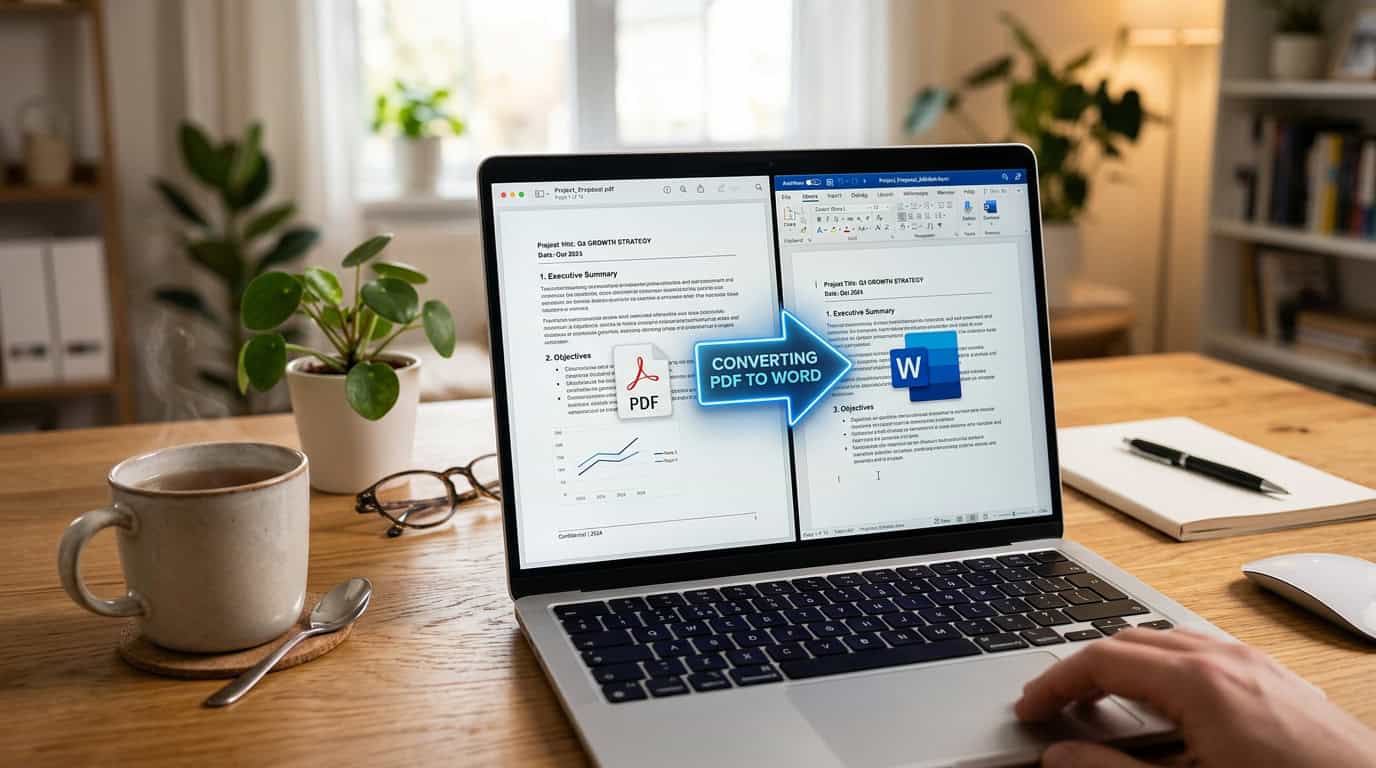
How to convert pdf to word free: 3 Simple Ways (2026)
I once stood in your shoes, staring at my computer screen in absolute panic. It was the morning of a major project proposal submission that I had spent all night formatting to pixel-perfect precision in Microsoft Word. Ten minutes before the final submission deadline, the director requested a single sentence change in the final PDF file. Because I had mistakenly misplaced the original editable Word file during a chaotic file transfer, I casually uploaded the PDF to a random online tool to convert pdf to word free so I could make the quick edit.
The output was a complete disaster: custom corporate fonts disappeared, table borders collapsed, text flew outside cells, and my neat ten-page document stretched into a messy twelve-page nightmare. Cold sweat ran down my back as I scrambled to fix the formatting with minutes to spare. Since that morning, I have tested every major conversion method to identify which ones preserve document layout and which ones will ruin your hard work. This guide shares the safest, most reliable methods to convert your files for free without breaking your formatting.
How to convert pdf to word free Without Losing Formatting
Most basic online conversion platforms rely on cheap, automated optical character recognition (OCR) engines. When they scan a PDF, they do not understand the underlying design rules of the document. Instead, they try to guess where columns, margins, and tables are located, often resulting in layout shifts.
If your document has custom fonts, online converters will replace them with default system fonts like Times New Roman or Arial. This font substitution alters the width of your words, which pushes text blocks to the next line and ruins your page alignment.
Furthermore, complex tables are notoriously difficult for automated tools to parse. The cell borders often disappear, and paragraphs inside cells merge together. To avoid these issues, you must choose the right conversion tool based on the complexity of your document. For example, a legal contract with strict formatting may require offline handling, while a scanned invoice benefits from strong OCR capabilities. Testing multiple approaches on sample files helps reveal which option maintains integrity across different document styles.
Method 1: Convert Using Desktop Microsoft Word (Best for Security)
If you already have Microsoft Word installed on your computer, you do not need any third-party websites or online tools. Microsoft Word has a built-in PDF conversion engine that handles text-heavy documents surprisingly well. This approach works by interpreting the PDF structure directly within the application, mapping elements like headings, paragraphs, and basic tables into editable Word components.
This method is the safest option because your document never leaves your local computer. It is ideal for confidential contracts, internal business reports, and files containing personal customer data. In practice, users handling sensitive financial summaries often prefer this route to maintain full control over data exposure.
Step-by-Step Guide:
- Open Microsoft Word on your desktop.
- Click on File, then select Open.
- Locate the PDF file on your computer and double-click it.
- Word will show a warning stating: “Word will now convert your PDF to an editable Word document. This may take a while…” Click OK.
- The software will process the file. Once finished, click Enable Editing at the top of the screen to start making changes.
After conversion, review the document for any minor spacing adjustments. For instance, a 15-page report with standard headings typically converts with over 90 percent of its original structure intact, though graphics may need repositioning.
- Pros: Highly secure, keeps text formatting clean, does not require internet access, supports batch processing of multiple files in newer versions.
- Cons: Struggles with complex graphical layouts, multi-column designs, or interactive PDFs. Users may need to recreate certain visual elements manually.
Method 2: Convert Online with Google Docs (Best for Scanned PDFs)
If your PDF is a scanned document (meaning it is essentially an image of text rather than selectable text), Google Docs is your best option. Google uses its proprietary search engine technology to power its built-in OCR. This process identifies characters from image-based pages and reconstructs them into selectable text, often preserving reading order even in multi-language files.
This method is completely free and works on any operating system, including Chromebooks and tablets, as long as you have a Google account. Professionals who digitize old paper archives frequently rely on this workflow for its accessibility across devices. Visit the official Google Drive site to begin the upload process.
Step-by-Step Guide:
- Go to your Google Drive and log in.
- Click the + New button on the left, then select File upload to upload your PDF.
- Once uploaded, right-click the PDF file in Google Drive.
- Hover over Open with and select Google Docs.
- Google will scan the document, convert the text, and open it in a new Google Doc.
- Click File, select Download, and choose Microsoft Word (.docx).
Consider a 20-page scanned research paper as an example. The OCR typically achieves 95 percent accuracy on clear prints, though handwritten notes may require manual corrections afterward.
- Pros: Excellent OCR for scanned documents, translates multiple languages accurately, integrates seamlessly with cloud storage for team collaboration.
- Cons: Completely strips out custom CSS-styled tables and advanced graphical borders. Complex layouts often require post-conversion cleanup of alignment issues.
Method 3: Use Dedicated Web Converters (Best for Complex Layouts)
For documents with highly complex structures, such as resumes, marketing flyers, or product catalogs, dedicated online converters are necessary. They use advanced layout preservation algorithms to keep your tables and images in place. Adobe offers a free online converter tool directly on their site, which is highly accurate because they created the PDF format. Another great option is Sejda, which allows you to convert up to three documents per day for free without registration.
Step-by-Step Guide:
- Visit the official Adobe PDF to Word online converter or the Sejda portal.
- Drag and drop your PDF file into the designated upload area.
- Click the convert button and wait for the processing to finish.
- Download the newly created Word document.
Testing on a sample brochure with embedded charts shows that these tools retain relative positioning better than basic OCR options. Just like learning how to clean up your document formatting is a skill that saves hours of manual work, similar attention applies to other file tasks.
- Pros: Best layout retention for tables, maintains relative spacing, high visual accuracy, handles vector graphics effectively in many cases.
- Cons: Uploading documents online carries minor security risks; free plans have daily usage caps. Always review output for subtle shifts in element placement.
Comparison Table: Which Method Should You Choose?
The table below outlines which conversion method fits your specific document type.
| Document Type | Best Method | Formatting Accuracy | Security Level |
|---|---|---|---|
| Confidential Contracts | Microsoft Word (Desktop) | High (Simple layouts) | Excellent (Offline) |
| Scanned Images / Invoices | Google Docs (Drive) | Medium (Text only) | Good (Cloud) |
| Multi-Column Resumes | Adobe / Sejda Online | High (Layout & tables) | Medium (Third-party) |
| Flyers & Product Brochures | Adobe Online Converter | Medium (Requires review) | Medium (Third-party) |
FAQ
Why is my converted Word document full of text boxes?
Some online converters turn every single line of text into an individual text box to preserve the exact visual layout. While this looks correct, it makes editing the document extremely difficult. Using Microsoft Word’s native import tool (Method 1) usually avoids this problem by converting text to standard paragraphs.
How do I edit a scanned PDF that cannot be highlighted?
You must use a tool with Optical Character Recognition (OCR). Both Google Docs (via Google Drive) and Adobe’s online converter have built-in OCR that reads the text inside images and turns it into editable characters.
Is it safe to upload confidential PDFs to free converter sites?
Reputable sites like Adobe or Sejda delete your uploaded files from their servers within a few hours. However, for highly sensitive documents containing financial or personal data, you should stick to offline conversion methods like desktop Microsoft Word.
What should I do if my tables break after conversion?
If a table collapses into plain text, highlight the broken text, go to the Insert tab in Word, select Table, and click Convert Text to Table. You can then define the columns based on the tabs or commas in the text to rebuild the grid.